
When buying an air conditioner, do not look at price and HP only.
If you choose the wrong unit, the room may cool slowly, electricity usage may go up, the compressor may work too hard — and you may regret it because the aircond does not really suit the space.
Before buying, these are the 8 things I normally check first.
If you are not sure whether to choose 1.0HP, 1.5HP or something bigger, start with the first section. That is the most important part.
Quick Answer: What Should You Check Before Choosing an Aircond?
- Room size
- The right HP
- Inverter or non-inverter
- Energy rating
- Useful features
- Refrigerant such as R32
- Total cost, not just the unit price
- Installation and after-sales service
1. Measure Your Room Size First
This is the most important step, and also the part many people get wrong. Measure the length × width of the space before thinking about brand or model.
| Room size | Estimated HP |
|---|---|
| Below ±200 square feet | 1.0HP |
| ±200–450 square feet | 1.5HP |
| ±450–700 square feet | 2.0HP |
This is only a guide, not a fixed rule. A room may need higher HP because of:
- High ceiling
- Number of windows
- Direct afternoon sun
- Top-floor rooms with roof heat
- Open-concept space
- Number of people in the room
- Heat from a nearby kitchen
If your space sits between two categories and gets afternoon sun, I usually suggest choosing slightly higher HP. Do not pick the smaller unit just to save money — the compressor may work harder and your electricity bill can end up higher.
Not sure which HP?
Measure the length × width of your space and WhatsApp me. I can help with an early estimate.
WhatsApp To Check Suitable HP2. Types of Air Conditioners
There are a few common types of aircond in the market:
- Wall-mounted / split — the most common type for homes
- Cassette — installed on the ceiling, usually for commercial spaces or larger areas
- Portable — movable, but usually less efficient and not the main choice for most homes
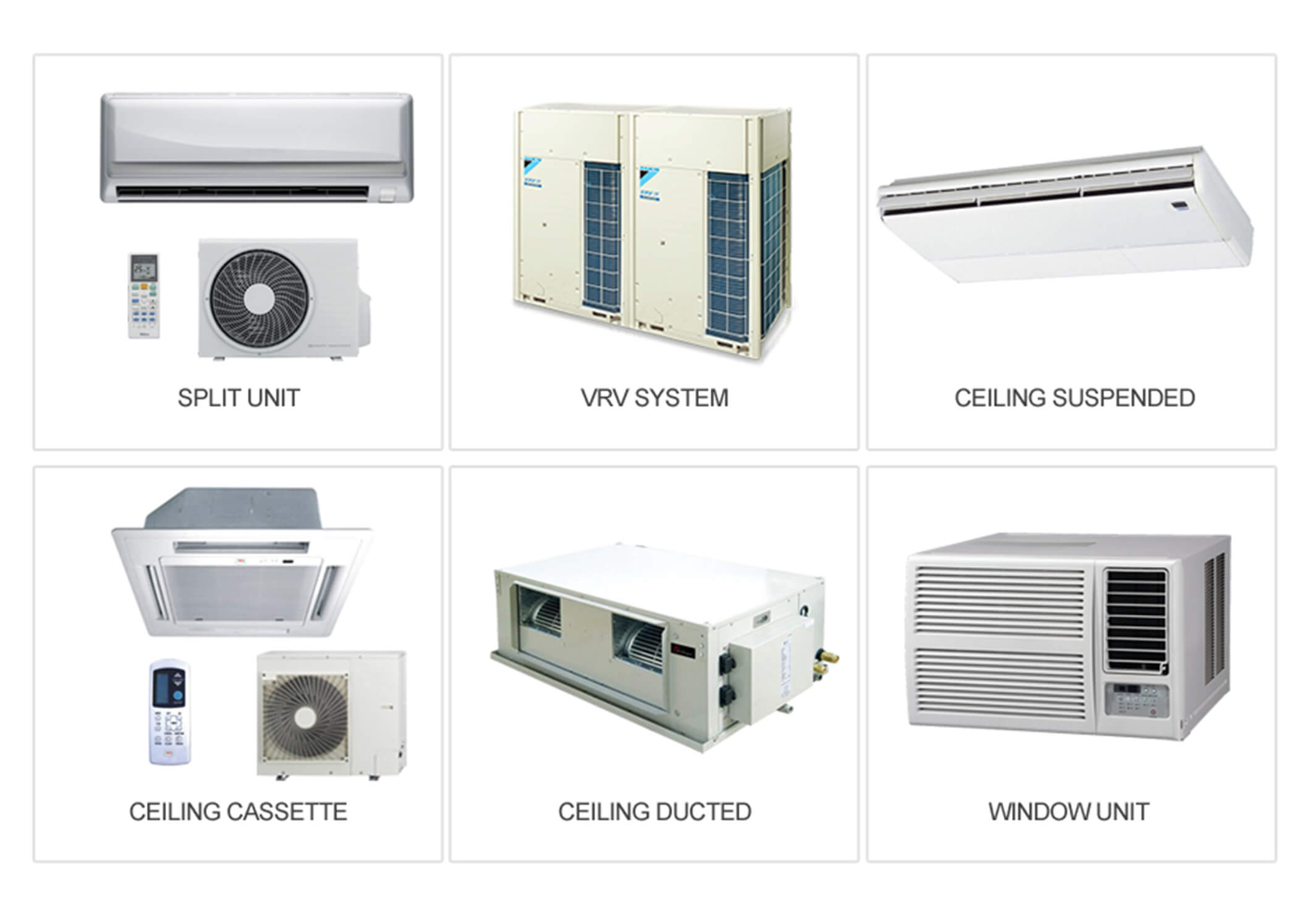
For most houses, apartments and condos, a wall-mounted split aircond is usually the most practical choice. It is easier to install, easier to service and the installation cost is usually lower.
3. Inverter or Non-Inverter
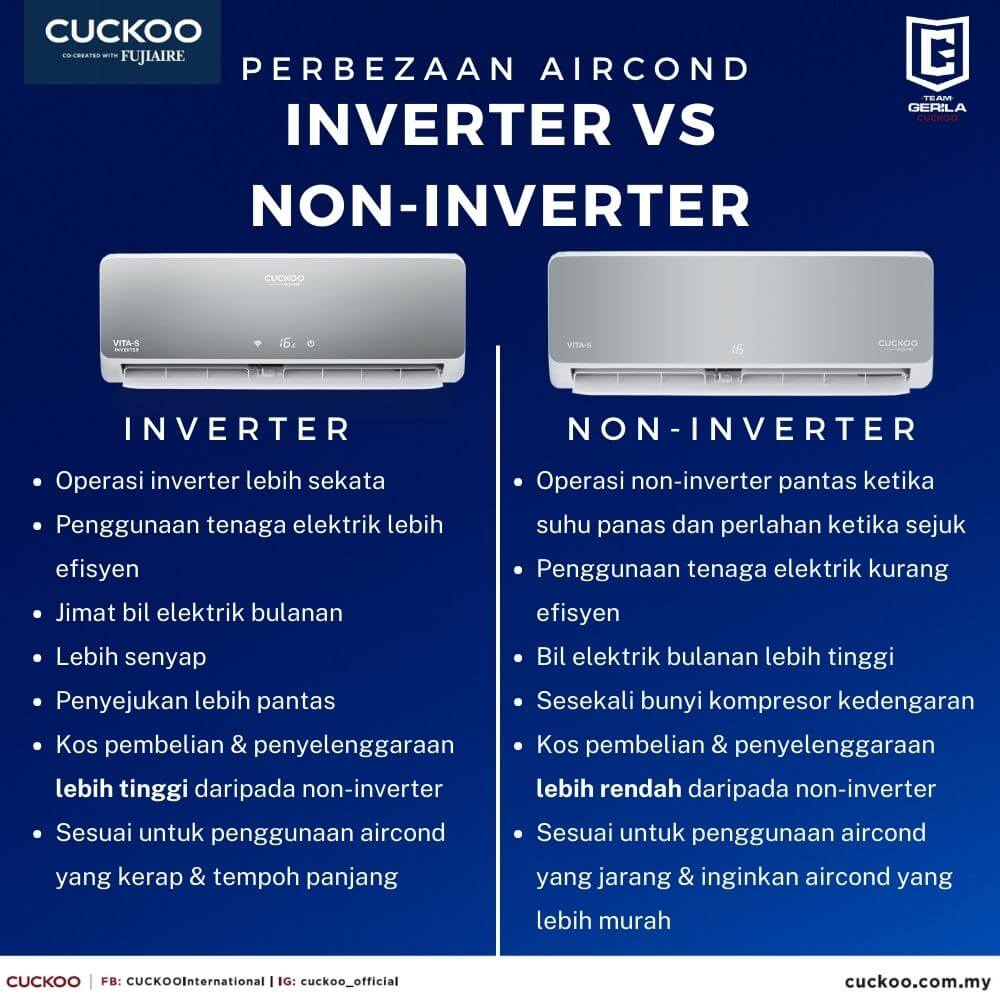
The main difference is the compressor. An inverter aircond can adjust its speed based on the room temperature. Once the room is cool enough, it does not keep switching on and off aggressively like a non-inverter unit.
Inverter aircond is usually more efficient for longer daily usage compared to non-inverter.
If you use it every night or for several hours a day, inverter is usually more practical — especially for bedrooms, living rooms and home offices.
Personally, if the aircond is used every night or for a few hours daily, I would lean towards inverter. If it is only used once in a while, non-inverter can still be considered.
4. Electricity Usage and Energy Rating
In Malaysia, aircond energy efficiency is measured with Energy Star Rating. The higher the star rating, the more efficient the electricity usage.
If two models are almost the same price, choose the one with the better energy rating. You may not feel the difference on the day you buy it, but you may feel it every month in your electricity bill.
5. Do Not Look at Cooling Only — Check Features You Will Actually Use
Modern air conditioners come with many features. But not all of them will be useful to you.
One common mistake is buying because the feature list looks long, but in daily use, you only turn it on and off.
Features that are usually useful:
- Fast cooling / Turbo — cools the room faster when you just reached home
- Wi-Fi / app control — lets you switch on the aircond before arriving home
- Additional filters — for example Vitamin C Filter or Silver Ion Filter
- Self / auto clean — helps reduce moisture inside the unit
- Air quality sensor — useful if your home gets dusty easily or is near a main road
- Timer & sleep mode — helps save electricity at night
- Scheduled service & maintenance support — this is what many people forget to think about
Scheduled servicing is something many people ignore when the aircond is still new. By the second or third year, then they realise it is not always easy to find a reliable person to service it.
6. Refrigerant Type (R32)
Aircond gas is the refrigerant. Without it, your aircond will not cool properly.
Many modern home air conditioners now use R32. In general, R32 has lower GWP compared to R410A and is commonly used in newer models.
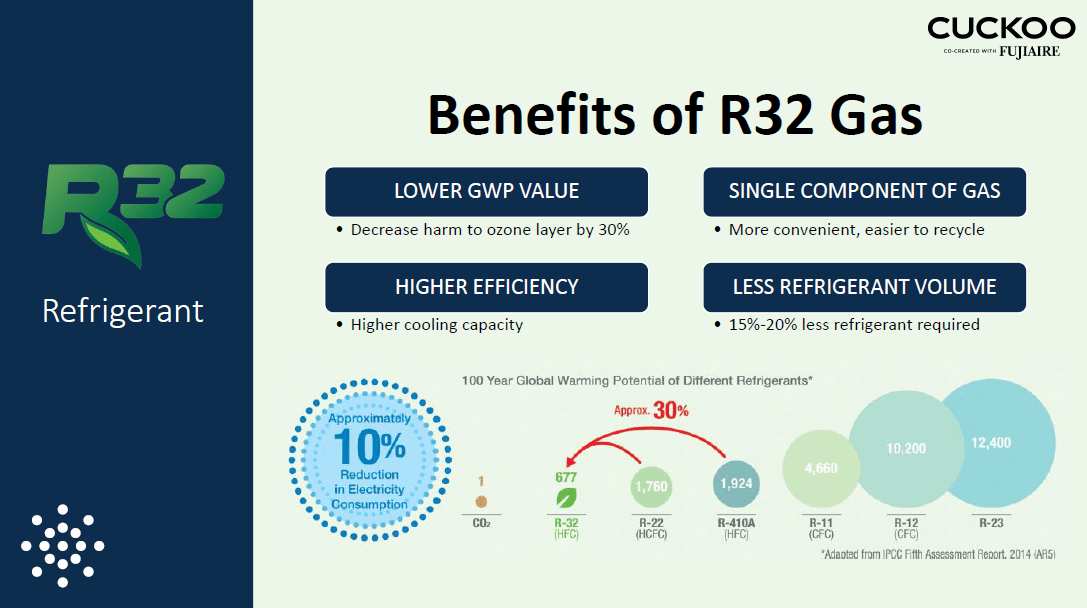
If you are choosing between two very similar models, R32 can be a sign that the model is newer. But do not make R32 the only reason to buy. Room size and the correct HP still matter more.
7. Do Not Look at the Unit Price Only
This is what many people miss. The sticker price is not the real total cost.
The real cost of an aircond includes:
- Unit price
- Installation cost
- Copper piping
- Wiring
- Outdoor unit bracket
- Drain pipe
- Additional piping charges
- Servicing
- Repair if it breaks down
- Spare parts
- Monthly electricity bill
- Warranty
- After-sales support
Calculate Total Cost, Not Just Sticker Price
An aircond that looks cheap at the start may not be the cheapest after 3–5 years.
8. Choose the Right Installer
Even an expensive aircond can become a problem if the installation is poor. A good installer will:
- Install neatly
- Protect your wall
- Keep piping and wiring tidy
- Make sure drainage flows correctly
- Test the unit after installation
- Explain additional charges, if any, before starting work
Before agreeing, ask these questions first:
What is included in installation?
- How many feet of copper piping?
- Is wiring included?
- Bracket?
- Drain pipe?
- Wall drilling?
- Additional piping charges?
- Removal of old aircond?
- Workmanship warranty?
5 Common Mistakes When Buying an Aircond
These are the mistakes I see most often:
1. Choosing HP that is too small because it is cheaper
The room cools slowly, the compressor works harder and electricity usage can go up.
2. Looking only at the unit price
Forgetting installation, extra piping, servicing and electricity cost.
3. Choosing non-inverter even though you use it every night
It may feel easier at the start, but the electricity bill comes every month.
4. Not thinking about service cost after buying
An aircond needs cleaning and servicing according to schedule, not only when it breaks down.
5. Choosing the cheapest installer
Poor workmanship, wrong drainage and you may end up paying twice.
Checklist Before Buying an Aircond
Keep this list. Once everything is checked, then compare prices.
- Measure the space
- Decide the right HP
- Choose inverter if you use it often
- Check energy rating
- Check refrigerant
- Check useful features
- Check installation
- Check warranty & service
- Calculate total cost
If You Want an Easier Option, Consider CUCKOO Aircond
If you like the idea of monthly payment + installation + service + more structured support, CUCKOO Aircond is worth shortlisting.
I am not saying everyone must take CUCKOO. But if you do not want the headache of finding your own installer, looking for service people and handling maintenance yourself, this kind of plan has real value.
Why I Recommend CUCKOO Aircond
Inverter
More efficient for daily use compared to non-inverter.
5-Star Energy
High energy efficiency rating for home aircond.
Basic installation included
No need to find your own installer.
Scheduled service
Service every 6 months, with more thorough maintenance every 18 months.
Warranty & support
There is a support channel if you need help, not disappear after installation.
Filters & sterilisation
Vitamin C Filter, Silver Ion Filter and UVC LED Sterilisation.
CUCKOO VITA 5TAR
If I had to start with one model that I often recommend for bedrooms and normal home spaces, this is it.
My recommendation
-Photoroom.webp)
CUCKOO VITA 5TAR
- Inverter
- 5-Star Energy
- Vitamin C Filter
- Silver Ion Filter
- UVC LED Sterilisation
- Scheduled service & basic installation
5-star inverter air conditioner for bedrooms, kids rooms or home workspaces.
Still comparing? You can read the VITA 5TAR review or check the full CUCKOO aircond price and package guide.
What Is Included in Basic Installation?
For the CUCKOO VITA 5TAR package, basic installation includes:
- Basic installation and delivery
- 10 ft copper piping and wiring
- 10 ft PVC pipe and insulation
- 13A plug
- Outdoor unit bracket
- Workmanship warranty
If the installation needs more than the standard allowance — for example trunking, 15A switch, additional piping or removing an old aircond — additional charges will apply. Ask first before work starts so there are no surprises at the end.
See Real Photos of CUCKOO VITA 5TAR
Catalogue photos are not enough. These are real photos of the indoor unit, outdoor unit, filter and remote so you can see how it actually looks before deciding.
Real photos
CUCKOO VITA 5TAR Up Close
Click any image for a full view. Swipe left or right to see more photos.
Swipe left / right to see more images
Summary: Check in This Order
If you want to buy an aircond for your home, check in this order:
Room size → HP → inverter → energy rating → R32 → installation → service → total cost.
After that, compare brands and prices. This helps you avoid buying an aircond that looks cheap, but does not suit your space and ends up costing more later.
Frequently Asked Questions
What HP is suitable for a 10 × 10 ft room?
A 10 × 10 ft room is about 100 square feet. For this size, 1.0HP is usually enough. If the room gets direct afternoon sun or has a high ceiling, check again because 1.5HP may be more suitable.
Is inverter really more energy-saving?
Inverter is usually more efficient, especially for long usage such as every night. If you only use the aircond occasionally for 1–2 hours, the saving may be less noticeable. For daily use, inverter is usually more practical.
Can 1.0HP be used for a large room?
It can be installed, but it may take longer to cool the room and the compressor may work harder. For spaces around 200–450 square feet, 1.5HP is usually more suitable. Choosing a HP that is too small is not always cheaper because the compressor may work harder and electricity usage can go up.
Is R32 better?
In general, R32 has lower GWP compared to R410A and is commonly used in newer aircond models. But do not choose based on R32 alone. Room size and the correct HP are still more important.
What is usually included in aircond installation?
For the CUCKOO VITA 5TAR package, basic installation includes 10 ft copper piping and wiring, 10 ft PVC pipe and insulation, 13A plug, outdoor unit bracket and workmanship warranty. Extra work such as trunking, 15A switch, additional piping or removing an old aircond will have additional charges.
How often should an aircond be serviced?
The mesh filter should be washed at least once a month. For scheduled maintenance, CUCKOO+ Care Service is carried out every 6 months, with more thorough maintenance every 18 months according to the service schedule.
Should I choose 1.0HP or 1.5HP?
1.0HP is usually enough for a normal bedroom, kids room or study room below around 200 square feet. 1.5HP is more suitable for spaces around 200–450 square feet, master bedrooms or warmer rooms.
What is the difference between buying a normal aircond and taking a CUCKOO plan?
Normal purchase: you pay upfront, find your own installer, and handle service and maintenance yourself. CUCKOO plan: you pay monthly, basic installation is included, scheduled service is arranged and there is a support channel if you need help.